Lifts have quietly become essential infrastructure in urban India — in offices, malls, hospitals, housing societies, metro stations, you name it. They make daily life possible for the elderly, the disabled, parents with prams and anyone above the second floor. Yet most lifts share one weakness: cut the mains power and the cabin stops where it is, with people inside. This is why uninterrupted lift power matters, and why a rescue device alone is not the answer.
- Lifts are now critical infrastructure
- Power cuts still trap people
- An ARD rescues — it does not run the lift
- Backup = continuity
- Hospitals & high-rises need it most
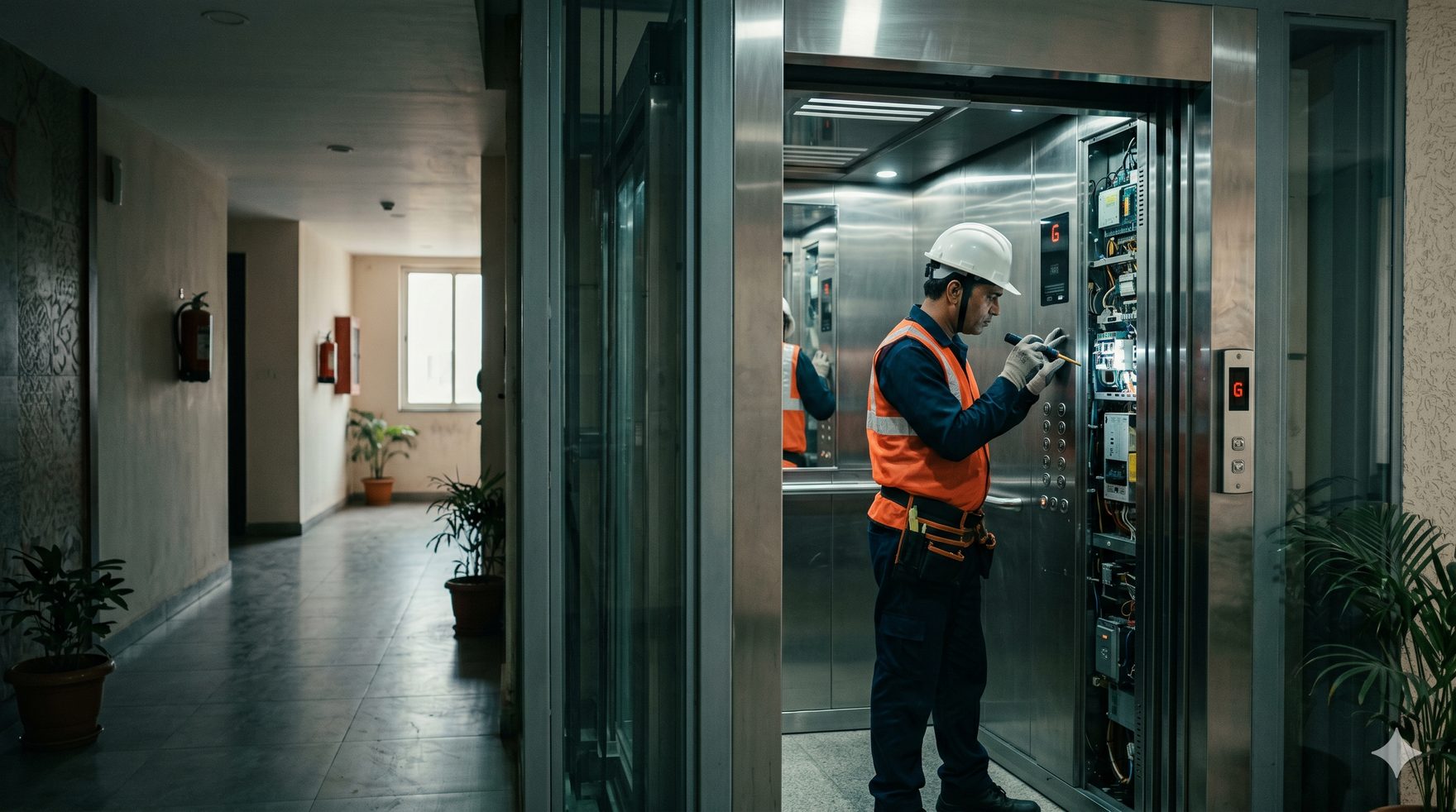
The lift became infrastructure — quietly, and fast
A generation ago a lift was something you found in a handful of city buildings. Today it is everywhere: in the housing society where a family lives on the fourteenth floor, in the hospital where a patient is wheeled between operation theatre and ward, in the mall, the office tower and the metro station. For a large share of residents the lift is not a convenience — it is the only practical way in and out. New to the subject? Start with what lift backup actually is.
As lifts have multiplied, so have the incidents tied to them — and a recurring theme is people stuck inside a stalled cabin. We keep reported cases on the public record in our lift accident news tracker, precisely because the same preventable causes keep coming up.
What actually happens when the power fails
An ordinary lift draws its power from the mains. When that supply drops — a grid trip, a transformer fault, load-shedding, a cable fault during the monsoon — the motor loses power and the lift halts. If the cabin is between floors, the doors stay shut and the occupants are trapped until either the supply returns or someone comes to release them by hand. In a tall building, or late at night, that wait can stretch from minutes into something far more frightening, especially for an elderly resident, a child, or a patient.
The danger is sharpest in an emergency. In a fire or a building evacuation, a lift that loses power becomes a sealed box at exactly the moment people most need to move — which is why fire-safety codes treat lift power as a life-safety issue, not a comfort feature.
A rescue device is not a backup
Most lifts in India are fitted with an ARD — an Automatic Rescue Device. It is useful, but it is widely misunderstood. An ARD does not keep the lift running. When the power fails the lift first stops and the lights go out; then, after roughly 20 to 30 seconds, the ARD moves the stalled cabin to the nearest floor and opens the doors so people can step out. It is a one-move evacuation aid — a pause in the dark followed by a lurch — not continuous operation.
Uninterrupted power is a different idea altogether. A lift inverter / lift UPS — the category the Emergency Rescue Device (ERD) belongs to — carries the cabin through the cut on battery, so the lift keeps moving to the floor the passenger actually chose, and there is no entrapment to be rescued from in the first place. We cover the distinction in detail in ERD vs ARD, answered.
Who needs it most
Every building benefits, but the case is strongest where a stalled lift is not just inconvenient but dangerous: hospitals and nursing homes, where patients are moved on stretchers and trolleys; high-rises, where the stairs are not a realistic option for many residents; buildings with a high share of elderly or disabled occupants; and any structure where the lift is part of the fire-evacuation plan. In each of these, continuity of lift power moves from a nice-to-have to a basic safety expectation.
Where the law is heading
Regulation is starting to catch up. Haryana has specifically made an Emergency Rescue Device compulsory for buildings above a certain height under its Lifts and Escalators (Amendment) Act, 2020. Most other states have Lift Acts that cover registration and maintenance but have not yet mandated a backup. Lift installation and safety are also governed nationally by BIS IS 14665, and the National Building Code sets out requirements for fire-evacuation lifts in tall buildings. We follow the state-by-state picture in our policy tracker.
How much backup is enough?
Once a building decides it wants continuity rather than just rescue, the next question is duration — and that is purely a function of the battery bank. A small bank gives a few minutes, which is often enough to let everyone reach a floor and step out safely; a larger bank gives a couple of hours; a very large one can run the lift for far longer. The right size depends on the lift’s motor load, how many lifts share one device, and the backup time you want — a multi-variable calculation, not a guess. You can work out the exact figure for your building on the battery-bank sizing calculator and read it more on why sizing matters.
The honest takeaway: an ARD rescues you once; a properly sized lift inverter keeps the lift working. Decide which one your building actually needs — then size it on the numbers, not on a vendor’s estimate.
Work out your building’s number
India’s free, open ERD / lift inverter sizing calculator — built on real field data.
Open the Sizing Calculator →