Most lift backup systems in India are sized by a salesperson, on a quote, in under five minutes. That single habit is responsible for two opposite — and equally expensive — mistakes. The free ERD sizing calculator exists to replace that guess with arithmetic.
One device, several names. “ERD” (Emergency Rescue Device), “lift inverter,” “lift UPS,” and plain “lift backup” all describe the same thing in the Indian market — the system that keeps a lift running through a power cut. New to the topic? Start with what lift backup is and why it matters. We use these terms interchangeably below, because your vendor will too. The name on the quote changes; the sizing math does not.
A lift backup is sized to a motor, not to a room
A home inverter is sized to “how many fans and lights.” A lift inverter — an ERD, or lift UPS — is sized to something far less forgiving: the peak power an elevator motor draws the instant it starts moving a loaded cabin, sustained for as long as the building needs the lift to keep running. That number depends on variables most people never see on a quote:
- Motor KVA & starting inrush
- Lift speed & travel height
- Counterweight balance
- Lifts per ERD
- Backup duration
- Battery: SMF / Tubular / Lithium
Change any one of these and the right answer changes. That is exactly the kind of multi-variable problem humans size badly by eye — and a lift backup calculator sizes correctly every time. If you want to understand what is happening inside the box, our ERD technology explainers walk through the power electronics that make a zero-break changeover possible.
The two ways sizing goes wrong
🚨 Undersized = unsafe
The lift UPS trips under load, the cabin halts between floors, and passengers are trapped — the exact scenario the ERD was bought to prevent. In a country among the worst globally for elevator incidents, “close enough” is a real risk, not a rounding error.
💸 Oversized = wasteful
Buy more KVA & a bigger battery bank “to be safe” and you pay for capacity your lift inverter will never use — plus a larger battery room, heavier wiring, and a bigger replacement bill every few years.
Vendor quotes are not neutral
Every manufacturer has an incentive baked into its recommendation — to sell a larger system, or to undercut a rival on price. Neither is aligned with what your building actually needs. An open, show-your-work lift backup calculator gives you a baseline you can verify before you ever talk to sales, so you can read a quote critically instead of taking it on faith. Cross-check the output against our published ERD specifications, and when a proposal lands 40% above the math, you will know to ask why.
Compliance is becoming non-negotiable
Haryana’s Lifts and Escalators (Amendment) Act, 2020 already mandates an emergency rescue device for buildings above 15 metres, and other states are moving the same way — you can follow the rollout in our state policy tracker. Sizing is no longer just an engineering nicety — it is how you prove an installation meets the mandate. Lift installation and safety are also governed by the national standard BIS IS 14665, summarised in our standards overview. A calculator that outputs the required ERD / lift inverter KVA and battery configuration gives RWAs and facility managers a defensible number on paper, not a verbal assurance.
What the calculator actually does
You select your lift brand, capacity, speed, and the backup duration you need. The tool returns the exact KVA and battery count for SMF, Tubular, or Lithium configurations — whether your vendor labels the box an ERD, a lift inverter, or a lift UPS. It is the same calculation an honest engineer would run, shown transparently rather than hidden inside a vendor’s spreadsheet. No black box, no login, no sales call.
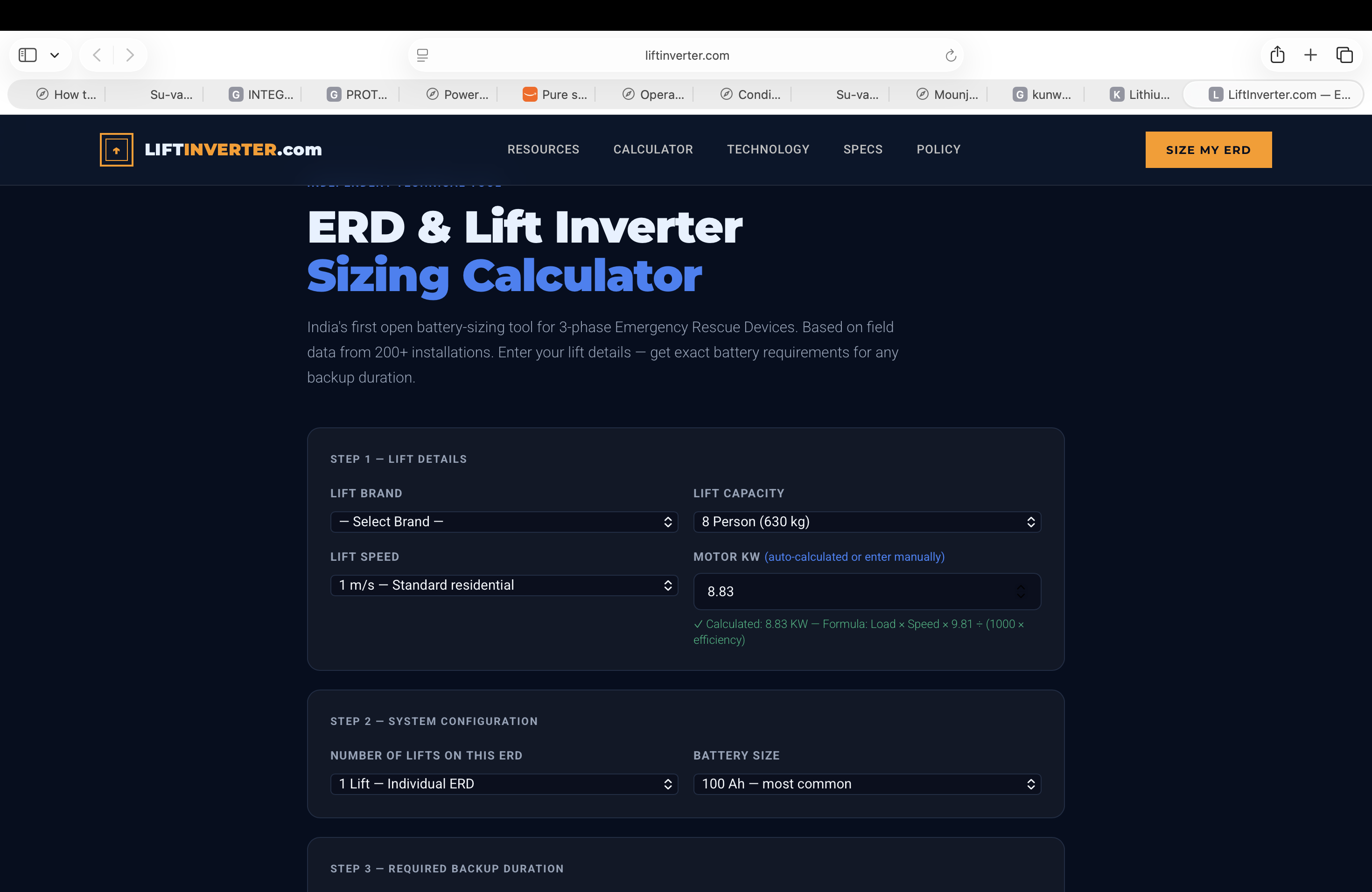
Motor KW is auto-calculated from load, speed and efficiency — or you can enter it manually. Pick your battery size and backup duration, and the lift backup calculator does the rest. It is built on field data from 200+ real installations, not a generic formula.
Who built it — and full disclosure. The calculator was designed by Kunwer Sachdev, the inventor of ERD technology, using field data gathered over several years at Su-vastika, the manufacturer he mentors (he holds no shareholding in it). The sizing logic — motor load × speed × efficiency, then battery-bank math — is standard engineering that holds for any brand; the real-world defaults behind it come from those Su-vastika installations. We tell you this openly so you can weigh the source for yourself.
The bottom line
Lift backup is one of the few building systems where getting the number wrong has consequences in both directions — danger if your ERD is too small, waste if it is too big. That is the definition of a problem worth calculating instead of guessing. Run your numbers first, then go shopping.
Frequently asked questions
What is an ERD sizing calculator?
An ERD sizing calculator works out the exact KVA rating and battery configuration a lift backup needs, based on your lift’s motor load, speed, number of lifts and required backup duration. It replaces a vendor’s rough guess with a transparent, repeatable calculation — so the device is neither undersized (which traps passengers) nor oversized (which wastes money).
Can I size a lift inverter or lift UPS myself without a vendor quote?
Yes. The sizing math — motor load multiplied by speed and divided by efficiency, then converted into a battery bank for your chosen backup duration — is standard engineering that does not depend on the brand. An open calculator lets you produce a baseline number yourself, then read any vendor quote critically against it before you commit.
Does Indian law require a lift backup or emergency rescue device?
In Haryana, the Lifts and Escalators Act as amended in 2020 requires owners of buildings above 15 metres to provide an emergency rescue device that brings a lift to the nearest floor and opens its doors during a power failure. Other Indian states are moving toward similar mandates, and lift installation and safety are also governed by the national standard BIS IS 14665.
Size your ERD in 60 seconds
India’s first open ERD / lift inverter sizing calculator — built on real field data.
Open the Sizing Calculator →