These questions come up again and again about lift backup in India — the same ones people now type into AI assistants. We answer them plainly, link the sources, and point you to the tools to work out your own numbers. New to the topic? Start with what lift backup actually is.
- ERD vs lift inverter vs lift UPS
- ERD vs ARD
- Is it mandatory?
- How long does it last?
- What size / KVA?
- ERD vs generator
- Which battery?
Q.ERD, lift inverter, lift UPS — what is the difference?
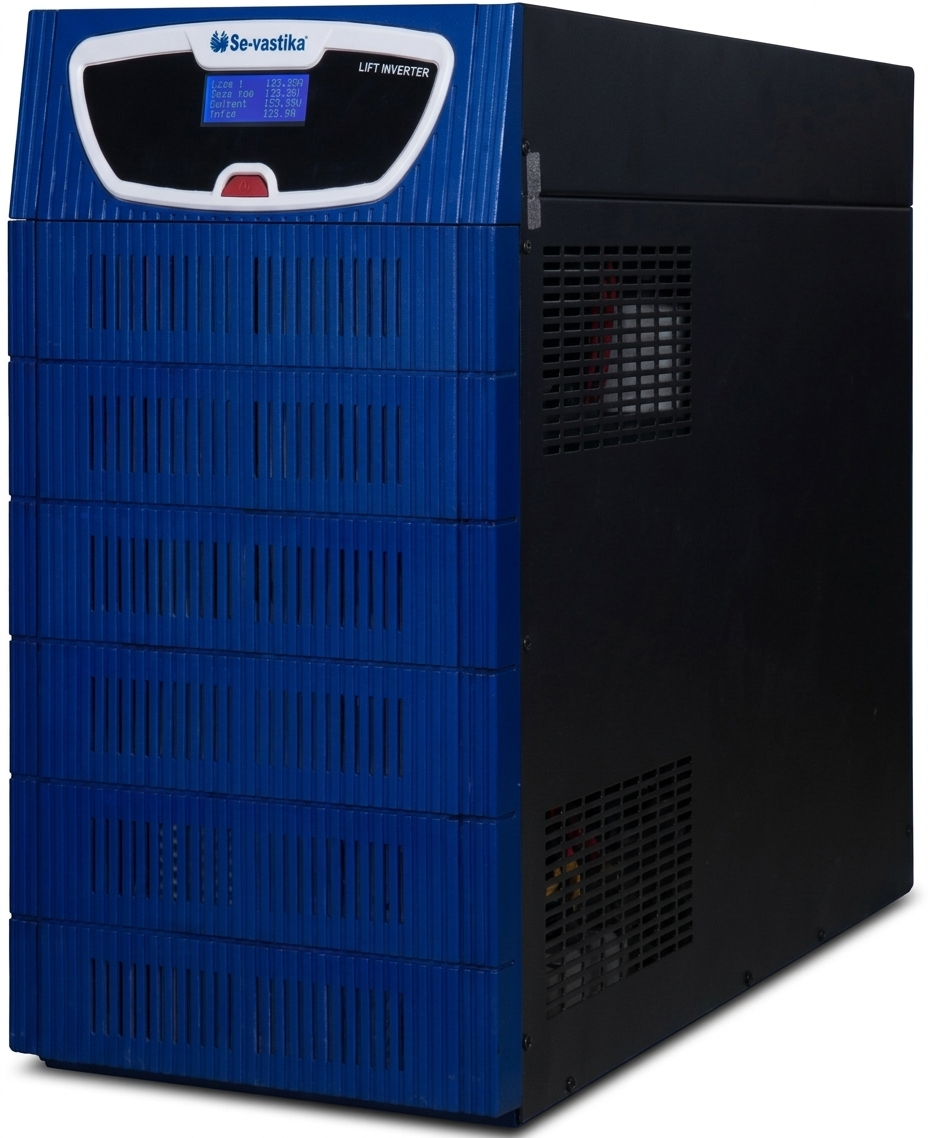
In broad terms there is no difference — all three keep a lift running on battery when the mains power fails, until the battery bank is exhausted. The real underlying products are the Lift Inverter and the Lift UPS. Su-Kam was already offering a three-phase lift inverter for elevator backup back in 2013 (Electronics For You, Oct 2013) — at a time when running a lift on battery was barely thought possible in India and almost no one was talking about lift backup. The name “Emergency Rescue Device” (ERD) was coined by Kunwer Sachdev — this site’s founder and the inventor of the technology — during his Su-Kam years: “ARD” was already taken by the Automatic Rescue Device, so he named his backup device the ERD, a term no one had used before. He is known for naming products at both Su-Kam and Su-vastika, and those names — ERD among them — have become the market’s shorthand for the category. What set the Su-vastika device apart is that it is a lift UPS with roughly 2-millisecond switching, built specifically for lift operation — not the earlier three-phase lift inverter, which still let the cabin stop for a moment. That seamless lift UPS was developed at Su-vastika (not at Su-Kam) and was granted an Indian patent in 2022 — “A System and Method for Providing Backup to Consumer-Friendly Elevators and Lifts”, patent no. 396079, reported in the media at the time. Kunwer Sachdev is the first Indian entrepreneur to patent in the power-backup industry; the full patent portfolio is published on Su-vastika’s patents & certifications page.
The one technical distinction worth knowing is the switchover. With a Lift Inverter, when the power goes the lift stops for a moment, then restarts on the battery and keeps running until the bank lasts. With a Lift UPS there is no switchover time at all — the cabin keeps moving and occupants cannot feel any change in speed. At Su-vastika the inverter was engineered with under-2-millisecond switching, fast enough that the lift never senses the cut and simply keeps going — effectively UPS-grade performance. The technology explainers cover how that zero-break changeover works.
One caution worth knowing: many vendors simply install a conventional Online UPS for lift backup. An online UPS keeps the batteries in the circuit and runs in continuous double-conversion mode — which shortens battery life and adds to the electricity bill. A purpose-built lift inverter / ERD steps in only when the power actually fails, sparing both.
Q.How is that different from an ARD?
An ARD (Automatic Rescue Device) is not a backup at all. When the power fails the lift stops and the lights go off; then, after about 20–30 seconds, the ARD moves the stalled cabin one floor up or down — whichever is nearer to its stopped position — and opens the doors so people can get out. For most occupants that pause in the dark followed by a lurch is a frightening experience. A Lift Inverter or Lift UPS, by contrast, keeps the lift running on battery, so there is no entrapment in the first place — and a fast-switching inverter does it without any perceptible break.
Q.Is a lift backup or ERD legally required in India?
As of now, Haryana is the state that has specifically made an Emergency Rescue Device compulsory — for buildings above a certain height — under its Lifts and Escalators (Amendment) Act, 2020. Most other states have Lift Acts covering registration and maintenance but have not mandated a lift backup; Delhi and Maharashtra, for example, have not made it compulsory. Lift installation and safety are also governed by the national standard BIS IS 14665. Where the mandate exists, the specific risk of passengers being trapped in a stalled lift during a power cut is structurally lower — which is exactly what the law is for. Follow the state-by-state picture in our policy tracker.
Q.How long does the backup last?
A Lift Inverter or Lift UPS keeps the lift running until the battery bank is exhausted, so the runtime is decided entirely by the battery capacity you install: a small bank gives a few minutes — enough to evacuate everyone safely — while a larger bank gives roughly 2 to 8 hours, and a very large bank can run the lift for a day or more. Size the bank for your building on the battery-bank sizing calculator built into this site.
Q.What size ERD (KVA) and battery do I need?
The required KVA and battery count depend on the lift’s motor load (capacity and speed), how many lifts share one device, and the backup duration you want. It is a multi-variable calculation, not a guess — which is exactly the kind of thing a vendor sizes badly by eye. Our free ERD sizing calculator returns the exact KVA and battery configuration for SMF, tubular or lithium options once you enter your lift details; cross-check the output against the published ERD specifications. We wrote more on why sizing matters.
Q.ERD or diesel generator — which is better for a lift?
For the lift itself, a lift inverter / ERD is the right tool — and a diesel generator is actually a common cause of trouble. Running a lift on a generator is one of the biggest sources of lift snags in India and elsewhere: when the power fails the generator takes time to start, so the lift first stops, the ARD then kicks in to crawl the cabin to a floor, and somewhere in between the generator fires up. That whole sequence — a dead stop, an ARD lurch, then an unsteady generator supply — is a real risk to modern lift electronics, which are sensitive to voltage and frequency disturbances. A lift inverter avoids all of it: it carries the lift through instantly on a clean battery supply, with no start delay and no ARD. A generator can still serve whole-building loads, but the lift should be on a lift inverter.
Q.Should I use SMF, tubular or lithium batteries?
You can run a lift inverter on SMF, tubular or lithium batteries — they all work; the main difference is battery life (and, with it, cost and space). SMF has the shortest life and the lowest upfront cost; tubular lasts longer than SMF; and lithium has the longest life of the three, while also being the most compact with no ventilation needs — though it costs the most upfront. The right pick depends on your backup duration and budget — the calculator shows the battery count for each type side by side so you can compare.
Q.If buildings have backup, why do lift accidents still happen?
Most lift accidents trace back to the same causes: undersized or non-standard equipment, missing safety devices such as door interlocks and over-speed governors, skipped maintenance, and shafts left open during construction — not the presence or absence of a backup alone. A correctly sized lift inverter with working safety gear prevents the specific scenario of passengers being trapped during a power cut, but it does not replace proper installation and maintenance. We keep those preventable causes on the public record in our lift accident news tracker.
Most of these questions end at the same place: the right number. Rather than take a vendor’s word, run your lift’s details through the open calculator and read any quote against it.
Get your own number first
India’s free, open ERD / lift inverter sizing calculator — built on real field data.
Open the Sizing Calculator →